
Journal · Wildlife
How a Tiger Sighting Actually Happens
Tigers are found by ear, not eye. What langur alarm calls tell a good naturalist, why we drive away from crowded sightings, and the six-drive rule that changes your odds.
Nobody finds a tiger by looking for a tiger. Adult tigers in Kanha or Bandhavgarh spend most of the day lying still in shade, striped and invisible at thirty metres. What you look for instead is the forest telling on them: a chital stamping, a langur barking from a high branch, a peacock going up loudly from the ground. The tiger is found by ear, several minutes before it is found by eye.
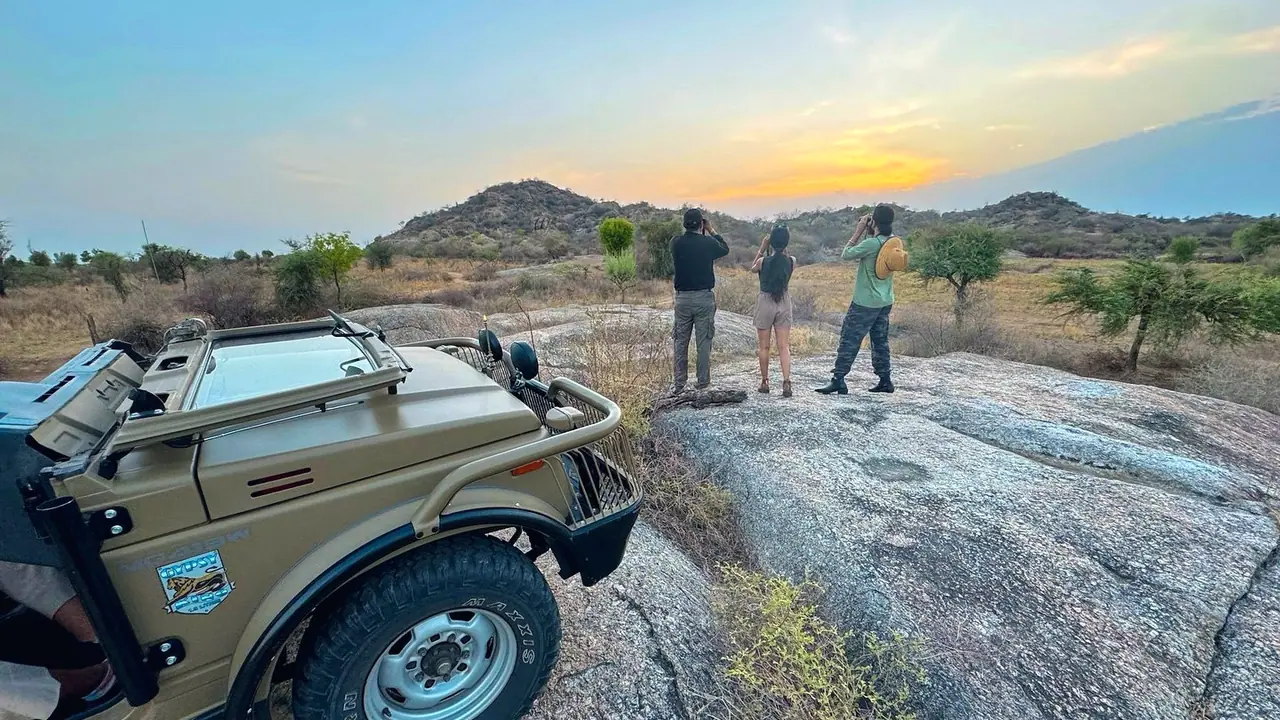
The langur is the best informant in the forest. It sits high, sees a long way, and has separate calls for a leopard on the ground and a tiger walking. A good naturalist will stop the jeep, switch off, and listen to how the calls move — a line of alarm travelling east through the sal means an animal is walking east through the sal, and you can go and wait where it will come out.
This is the opposite of how most safaris are run. The common method is radio: one jeep sees something, calls it in, and eleven vehicles arrive within four minutes, engines running, everyone standing on the seats. You will probably see a tiger. You will see it through a gap between two other jeeps, with a stranger’s elbow in your rib, and you will not remember much about the forest.
Our naturalists work to a rule: if four vehicles are already at a sighting, we go elsewhere. It sounds austere and it costs us the occasional complaint on day two. By day four it has usually paid — a sloth bear crossing a fire line with nobody else there, or a pack of dhole hunting in the early light, which is rarer than the tiger and much harder to arrange a crowd around.
Practical things that change the odds. Book six drives, not three: the arithmetic of sightings is brutal and three drives is a coin toss. Go in April or May, when water is scarce and animals come to it, and accept 42°C. Take a park with fewer permits — Satpura, where you can also walk and canoe — over the famous ones. Sit on the left in the morning, for the light.
And a word about not seeing one. Roughly one guest in six leaves a three-night stay without a tiger. We say so before you book, because a park that promises otherwise is lying or driving badly. What you will have instead, if the naturalist is good, is four days of learning to read a forest — which is a longer-lasting thing than a photograph taken over someone’s shoulder.